Nested Model of Resilience
Resilience is often understood as something that resides within the individual—the capacity to withstand adversity, recover from difficulty, or continue functioning under stress. While individual capacities matter, this understanding is incomplete.
We do not develop or sustain resilience alone.
Our nervous systems exist in a constant state of call and response with the environments around us. Our ability to remain connected, flexible, and responsive is shaped not only by what happens within us, but also by our relationships, the teams and communities in which we participate, and the larger systems that surround us.
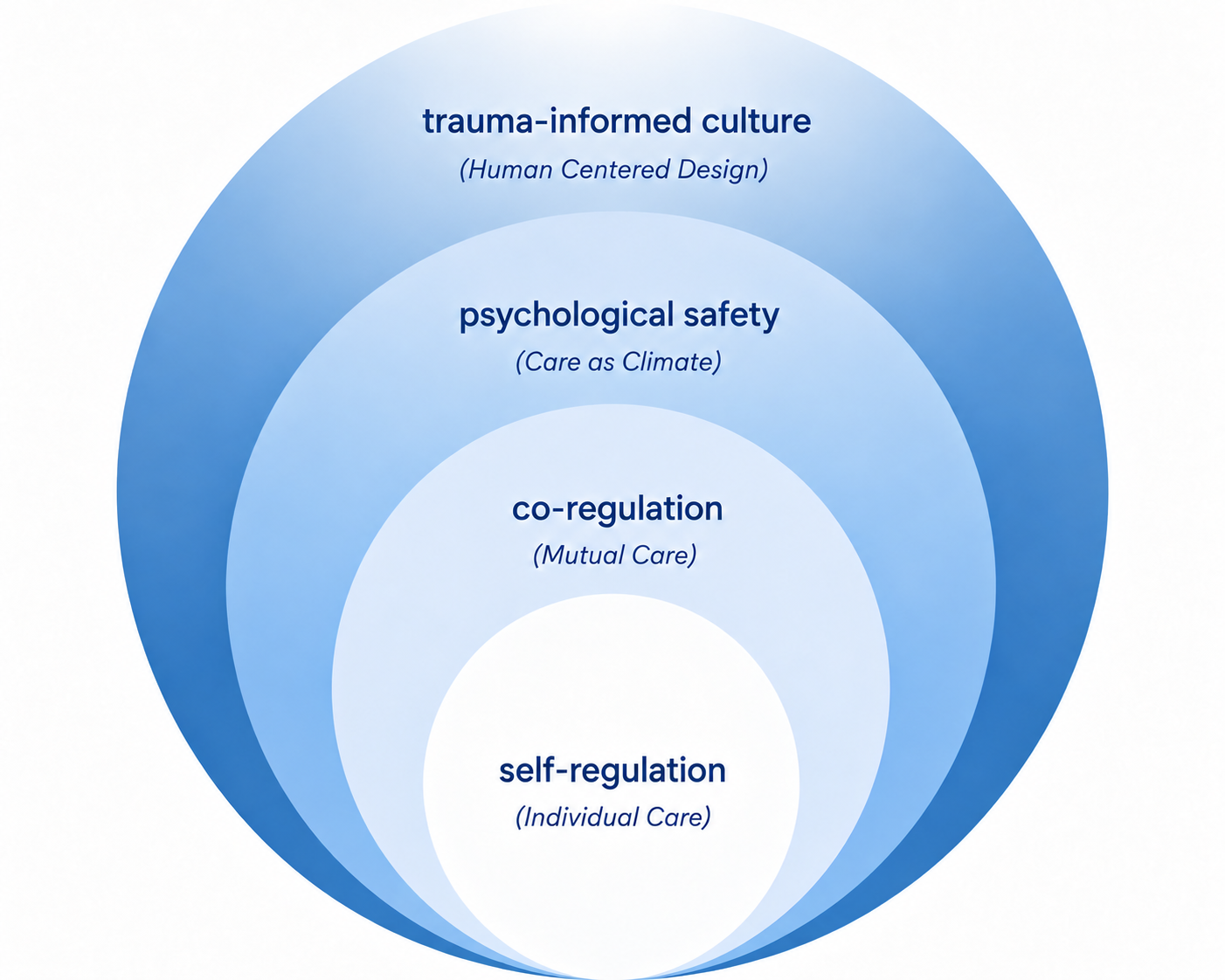
The Nested Model of Resilience offers a way of understanding these interconnected layers of human experience.
Individual → Relationship → Team → Organization
At the individual level, care is expressed through self-regulation.
At the relational level, care is shared through co-regulation.
At the team level, care is experienced through the cultivation of psychological safety.
At the organizational level, care is actualized through human-centered culture and design.
These layers are nested because none exists in isolation. Individuals participate in relationships. Relationships contribute to the climates of teams. Teams exist within organizational environments. And those environments continually shape and act upon the people, relationships, and teams within them.
Care is the animating principle within and between these layers.
Individual—Self-Regulation & Self-Care
Just as in leadership, the work begins within.
At the individual level, resilience involves developing and enhancing the capacity to attend to our internal experience and care for the conditions that allow us to function at our best. This includes the foundations of psychological wellbeing—sleep, activity, nourishment, and social connection—as well as our cognitive, emotional, physiological, relational, and spiritual lives.
Self-awareness makes this care possible. As we learn to notice our thoughts, emotions, nervous system states, beliefs, patterns, and sense of purpose, we create greater possibility for psychological flexibility, emotional agility, and autonomic flexibility. Rather than being driven automatically by stress or protective reactions, we become more able to pause, reflect, and choose responses that align with our values and desired impact.
Self-regulation is not about maintaining a constant state of calm or becoming unaffected by the circumstances around us. It is about increasing our capacity to notice where we are, understand what we need, and move flexibly through the range of states required by life.
This inner work matters beyond the individual because the state of our interior world inevitably enters the spaces we share with others. Tending to the world within changes how we enter and participate in the world around us.
Individual care begins with learning to tend to the world within.
Relationship—Co-Regulation/Mutual Care
Human beings are inherently relational. Our nervous systems do not operate independently of one another; we are continually influencing and being influenced by the people around us.
The state of our interior world is expressed, implicitly and explicitly, through our interactions. As we become more regulated ourselves, we become more capable of meeting another person with presence, curiosity, reflective listening, attunement, and responsiveness. These qualities create the conditions for co-regulation—the ways our nervous systems help one another move toward greater safety, connection, and capacity.
This is where self-care flows into mutual care.
Mutual care means recognizing that every person we encounter is carrying an interior experience that we cannot fully see, but whose impact we will inevitably feel. When enough relational safety exists, people can become known and understood rather than encountered only through their role, work activity, or output.
These interactions do not happen in a vacuum. Regulated nervous systems and expressions of mutual care influence the people in close proximity. Repeated experiences of presence, responsiveness, and co-regulation can create pockets of care—relational spaces that offer an alternative even when the larger environment does not yet embody those same qualities.
The relational question becomes:
What is happening within the person next to me, and how might we tend to it?
Team—Psychological Safety & Team Climate
Relationships accumulate into climates.
Over time, repeated interactions created shared expectations about what is safe to say, whose voices matter, how mistakes are treated, whether disagreement is welcome, and what happens when someone needs help. Teams are living systems: they form, evolve, experience conflict, adapt, and change. Their health therefore requires ongoing attention.
At this level, care takes form through the cultivation of psychological safety.
Psychologically safe teams cultivate conditions in which people can know others and be known, depend upon one another, share responsibility for the work, acknowledge uncertainty, ask questions, disagree, make mistakes, and contribute more fully. Safety, trust, and respect become the foundation from which both human flourishing and effective performance can emerge.
Psychological safety is not simply an idea or value that a team declares. It is a living, embodied experience cultivated through predictability and consistency across time. Clear expectations, shared agreements, honest communication, responsiveness to rupture, and alignment between what is said and what is actually experienced all help the nervous system shift energy away from vigilance and toward engagement.
The goal is not to create a team without discomfort, disagreement, or challenge. It is to create a climate safe enough for people to remain connected, curious, and engaged when those experiences arise.
Team climate is care made collective.
Organization—Human Centered Design & Culture
Organizations create conditions.
Policies, practices, structures, hierarchies, workloads, decision-making processes, incentives, expectations, and distributions of power all shape the lived experience of the people within them. These structures can either support or impede the flow of care through everyday organizational life.
At the organizational level, culture is care at scale.
Human-centered design begins with a recognition of the human condition: our nervous systems are continually responding to the environments around us. When people experience chronic stress, uncertainty, exclusion, or threat, energy and cognitive resources are directed toward survival. When people experience greater safety, predictability, trust, agency, and belonging, they are better able to access the capacities that support learning, creativity, collaboration, problem-solving, wellbeing, and meaningful contribution.
Good intentions alone do not create healthy cultures. Values must take form through the actual conditions people encounter. We build an infrastructure of care when policies, processes, structures, and standards are designed with attention to their impact on the human beings who experience them.
Organizational culture is not fixed. It is continually renewed and recreated through interactions, decisions, structures, assumptions, and patterns of behavior. This means that even cultures shaped over decades by stress, scarcity, fear, efficiency, habit, or power imbalances can evolve.
A human-centered organization asks not only whether a policy is efficient or whether a structure accomplishes its intended task, but also:
What does it feel like to be a human being within the conditions we have created?
A Bi-Directional Relationship
Although the model is visually represented as nested layers, resilience does not move only in one direction.
Individual → Relationship → Team → Organizational Field
and
Organizational Field → Team → Relationship → Individual
Change moves in both directions.
The inner work of an individual changes the relationships in which they participate. The quality of those relationships influences team dynamics. Teams can become pockets of a different culture. Leaders shape and support conditions within those pockets, while senior leaders steward conditions across the larger organizational field.
And through it all, organizational structures shape the experience of every individual.
This reciprocal movement means resilience is neither solely an individual responsibility nor something that can be created entirely through organizational policy. We are simultaneously individuals, participants in relationships, members of teams, and inhabitants of larger systems. Each level influences—and is influenced by—the others.
Care is what moves between them.
We care for ourselves by tending to our interior worlds. We care for one another through presence, responsiveness, and co-regulation. Repeated experiences of mutual care help create psychologically safe teams. Those teams influence cultures around them. And when organizational structures themselves are designed with human beings in mind, they create conditions that make self-regulation, connection, mutual care, and psychological safety more possible.
Care therefore exists both as a practice within the system and an emergent property of the system.
The goal is not to create organizations in which people are instructed to care for one another. It is to cultivate conditions in which care becomes an emergent property of everyday organizational life.
No one person has to control the entire field to participate in changing in. The Nested Model is not so much a hierarchy of responsibility as a recognition of our nested spheres of influence. We begin where we are. We cultivate the world within. We tend to the relationships around us. We create pockets of care and co-regulation. We cultivate the conditions within our corner of the organization. And those responsible for the larger field steward the conditions that allow human beings to flourish.
We each tend the part of the field that is ours to tend.
Explore the Series
The Nested Model of Resilience has developed through a series of essays exploring how care takes form across the individual, relational, team, and organizational levels.
If you would like to follow the fuller development of the framework, you can begin with the original essay, The Nested Model of Resilience, and continue through the related pieces on self-regulation, co-regulation, psychological safety, organizational culture, and leadership.